

iBrick Review: A Hands-On STEM Homeschool Curriculum Kids Actually Want to Do
One thing I’ve learned from homeschooling is that sometimes the best curriculum doesn’t look like curriculum at all.
That’s exactly how I feel about iBrick.

iBrick combines brick building with digital lessons, step-by-step instructions, engineering concepts, and challenges that encourage kids to actually use what they’ve learned.
And after watching my son sit down and work through the projects himself, I immediately understood why this was included in our Timberdoodle homeschool curriculum kit.


It’s hands-on. It’s engaging. And most importantly, it gives kids who love to build something productive to do with that interest.
What Is iBrick?
iBrick is a hands-on STEM program that uses LEGO-compatible bricks and an online learning platform to teach kids through building.
Students follow digital instructions to create working models using components like gears, axles, motors, beams, and bricks.


The projects are paired with STEM lessons and challenges designed to move kids beyond simply copying a model and into understanding how and why it works.
iBrick describes its approach as “one kit, endless models,” and that really is one of the biggest benefits. The same reusable set of pieces can be used to complete many different projects rather than building something once and being finished with the kit.
For this review, we focused on the iBrick basketball goal, and it was such a good example of what that looks like in practice.


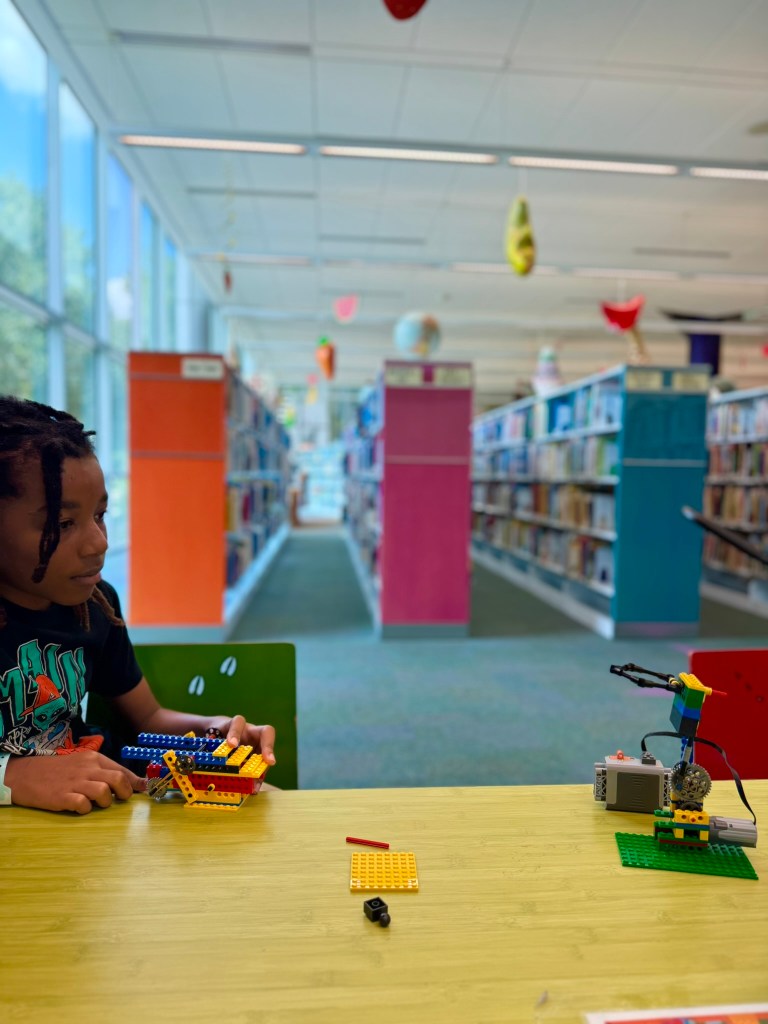
What started as a collection of bricks, gears, axles, and a motor slowly became a working basketball setup as my son followed the digital instructions step by step.
And because the build uses moving mechanical parts, he wasn’t simply stacking bricks to recreate something that looked like a basketball goal — he was building the mechanism that makes it work.


What Comes With iBrick?
The first thing I noticed was how organized everything is.
The kit contains the building pieces students need for the projects, including traditional brick-style pieces alongside mechanical components such as gears and axles. Everything fits into an organized storage tray, which I appreciate because STEM kits with hundreds of loose parts can become chaos quickly.

The physical kit works alongside iBrick’s digital platform, where students access their projects and instructions.
And this isn’t simply a box of bricks with a PDF telling kids what to make.
Each iBrick project follows a learning sequence that includes a hands-on build, STEM instruction, and a challenge that lets kids apply the concept they just explored.


Our Experience Using iBrick
This is where iBrick won me over.
My son loves building. Give him something he can construct, take apart, figure out, modify, or make move, and he’s interested.
So when he opened iBrick, I didn’t have to convince him that this counted as school.
He logged into the digital curriculum, chose a project, pulled out the kit, and started building.
We worked through the basketball project, which turned out to be a pretty substantial build. The digital instructions walked him through it piece by piece, from the base and structural components to the gears and moving mechanism.


I loved watching the project change as he progressed because there was a point where it was just a handful of connected pieces on the table — and then suddenly you could see the basketball goal taking shape.
The instructions are visual and broken into individual steps, so he could look at the model on the screen, identify the pieces he needed, build that section, and continue.
And I got to sit there and watch him work.
Not listen to a lecture about engineering.
Not complete a worksheet about gears.
Actually use gears.
That distinction matters to me.


It Teaches Engineering Through Doing
My favorite part of iBrick is that the engineering isn’t theoretical.
As my son built, he was physically working with gears, axles, motors, structural pieces, connections, and moving parts.
He had to look closely.
He had to determine which piece matched the diagram.
He had to notice when something wasn’t lining up correctly.
And when a section didn’t work the way it was supposed to, he had to go back and figure out where the build went wrong.


That’s problem-solving happening naturally.
According to iBrick, its projects are designed to introduce STEM and engineering concepts while developing skills such as problem-solving, creativity, and critical thinking. The curriculum was developed with engineers and education/child-development professionals.
But honestly, I didn’t need the website to tell me that part.
I could see it happening at the table.

iBrick Is More Than Building Instructions
This was something I didn’t fully understand until we actually used it.
The building is only one part of the program.
After the hands-on portion, iBrick includes educational content explaining the STEM ideas behind the project, followed by challenges that encourage students to experiment and apply what they’ve learned.
That changes the experience from:
“Build this model.”
to:
“Build it. Understand it. Now see what you can do with it.”
And that is much closer to the type of STEM learning I want in our homeschool.
Once the basketball goal is built, the experience doesn’t simply end with, “Great, you made it!” The online curriculum continues into the basketball lesson and iBrick Challenges, giving students a reason to use and think about what they just created.
That was one of my favorite parts of the project because the finished model becomes part of the learning experience instead of just becoming something that sits on the table after the final instruction.

One Kit Can Be Used Again and Again
This may be my favorite feature as the person who has to store all of our homeschool materials.
You do not receive a completely new box of parts for every lesson.
The iBrick kit is reusable. Students take apart previous projects and use the pieces to create new models throughout the program. iBrick says its digital library supports hundreds of models using the same core kit.
That means the value isn’t in one impressive finished project.
The value is in everything they can build with the materials over time.
It also means we’re not collecting a shelf full of half-used STEM boxes with four specialty pieces in each one.

Can Kids Use iBrick Independently?
For us, this was one of its biggest strengths.
Once my son understood where everything was and how the platform worked, the format was straightforward enough for him to work through the building process largely on his own.


That doesn’t mean a child will never need help. Some projects are detailed, and occasionally figuring out what went wrong is part of the experience.
But I don’t have to teach an engineering lesson beforehand to make iBrick useful.
The curriculum provides the structure.
That makes it especially appealing for homeschool parents who want to incorporate more STEM but don’t necessarily feel confident teaching engineering themselves.


Who Would I Recommend iBrick For?
I would especially look at iBrick for a child who:
loves LEGO-style building, takes things apart to see how they work, enjoys machines or mechanical projects, learns better by doing, has an interest in engineering, or gets bored with traditional textbook-heavy lessons.
iBrick currently offers age-based programs and describes its broader educational program as serving children through the elementary and middle-school years.
But I think learning style is just as important as age here.
This is for the kid who needs to touch the lesson.

What I Like Most About iBrick
There are plenty of STEM products that are fun.
There are plenty of curricula that are educational.
Finding something that genuinely feels like both is harder.
iBrick gets pretty close.
My son wasn’t pretending to enjoy an educational activity because I told him it was fun. He was sitting at the table building something because building is already something he enjoys.

The education gets woven into that.
And as a homeschool mom, that’s exactly the kind of curriculum I want more of.
I don’t want every subject to require convincing.
Sometimes I want to put the materials on the table and watch curiosity take over.

iBrick and Timberdoodle
We discovered iBrick through Timberdoodle, where it was included as part of our homeschool curriculum kit.
And honestly, this is one of the reasons I’ve enjoyed exploring Timberdoodle’s curriculum choices.
A complete homeschool education doesn’t have to mean math book, science book, language arts book, repeat.
There is room for building.
Creating.
Engineering.
Problem-solving.
And figuring out why the thing you just built isn’t moving until you realize one tiny gear is in the wrong place. 😂
For a child who genuinely loves to build, iBrick gives that interest a place in the school day instead of treating it as something they only get to do after school is finished.
And that may be my favorite thing about it.

Is iBrick Worth It?
For a hands-on learner or a child interested in building and engineering, yes, I think iBrick is absolutely worth considering.
It combines a reusable building kit with structured digital lessons and STEM challenges, so it offers much more longevity and educational value than a single-build activity.
But the biggest win in our house?
He wanted to do it.
And sometimes that is the best homeschool curriculum review I can give.
You can find iBrick through Timberdoodle and see how it fits into their homeschool curriculum kits here: click here.


