25 Fun Learning Activities for 4 Year Olds at Home
Looking for learning activities for 4-year-olds that are actually fun enough to hold their attention?
Four has been such an interesting age in our house. My four-year-old can sit down and work on letters, numbers, and even writing his name, but that does not necessarily mean he wants to.

Most days, he would much rather be moving, building, pretending, playing a game, or doing just about anything that doesn’t look like traditional schoolwork.
And honestly? That is okay.
As a former teacher and now a homeschooling mom, one thing I have learned is that young children don’t have to sit at a table for hours for learning to count.
So instead of trying to turn our entire day into preschool, I look for little opportunities to sneak learning into things he already enjoys.
These educational activities for 4 year olds work on early reading, math, fine motor skills, problem-solving, creativity, language, and even independence — without making your preschooler feel like they’re doing school all day.

What Should a 4 Year Old Be Learning?
At four, I am much more interested in building a strong foundation than trying to rush into kindergarten-level academics.
Some of the skills we naturally work on include:
- Recognizing letters and beginning letter sounds
- Recognizing numbers and counting objects
- Writing or recognizing their name
- Sorting and identifying patterns
- Building vocabulary
- Following simple directions
- Cutting, drawing, coloring, and strengthening fine motor skills
- Problem-solving
- Taking turns
- Completing simple tasks independently
- Using imagination and creativity
Most importantly, I want learning to still feel exciting.
You don’t need to work on all of these things every day. A quick activity in the morning, reading together later, helping make lunch, and building something with blocks can add up to a surprisingly full day of preschool learning.
1. Go on a Letter Scavenger Hunt
A letter scavenger hunt is one of the easiest learning activities for 4 year olds at home because your child gets to move.
Write letters on sticky notes and place them around the room. Have your child find each one and tell you which letter they found.
You can make it easier by focusing only on the letters in their name or more challenging by asking for the sound each letter makes.
Skills practiced: letter recognition, phonics, movement, visual discrimination
2. Build Their Name
Instead of sitting down and repeatedly writing their name, let your preschooler build it.
Write each letter of their name on a separate piece of paper, magnetic letter, craft stick, or block. Mix the letters up and let them put their name back in order.

Once they become comfortable with their first name, you can try a last name or other familiar words.
Skills practiced: name recognition, letter recognition, sequencing
3. Count Toys Instead of Worksheets
Four-year-olds can practice early math with the toys they already love.
Grab toy cars, blocks, dinosaurs, dolls, LEGOs, or anything else you have around the house and ask your child to count out a certain number.
“Can you give me five cars?”
“Can you build a tower with eight blocks?”
Now you’re working on counting and one-to-one correspondence without pulling out a worksheet.
Skills practiced: counting, number sense, following directions
4. Make Play Dough Letters and Numbers
Play dough is one of my favorite preschool supplies because it works on so many skills at once.
Have your child roll the dough into long pieces and use them to form letters, numbers, shapes, or even their name.
You can also simply let them create whatever they want and talk about what they made.

Looking for more preschool learning activities?
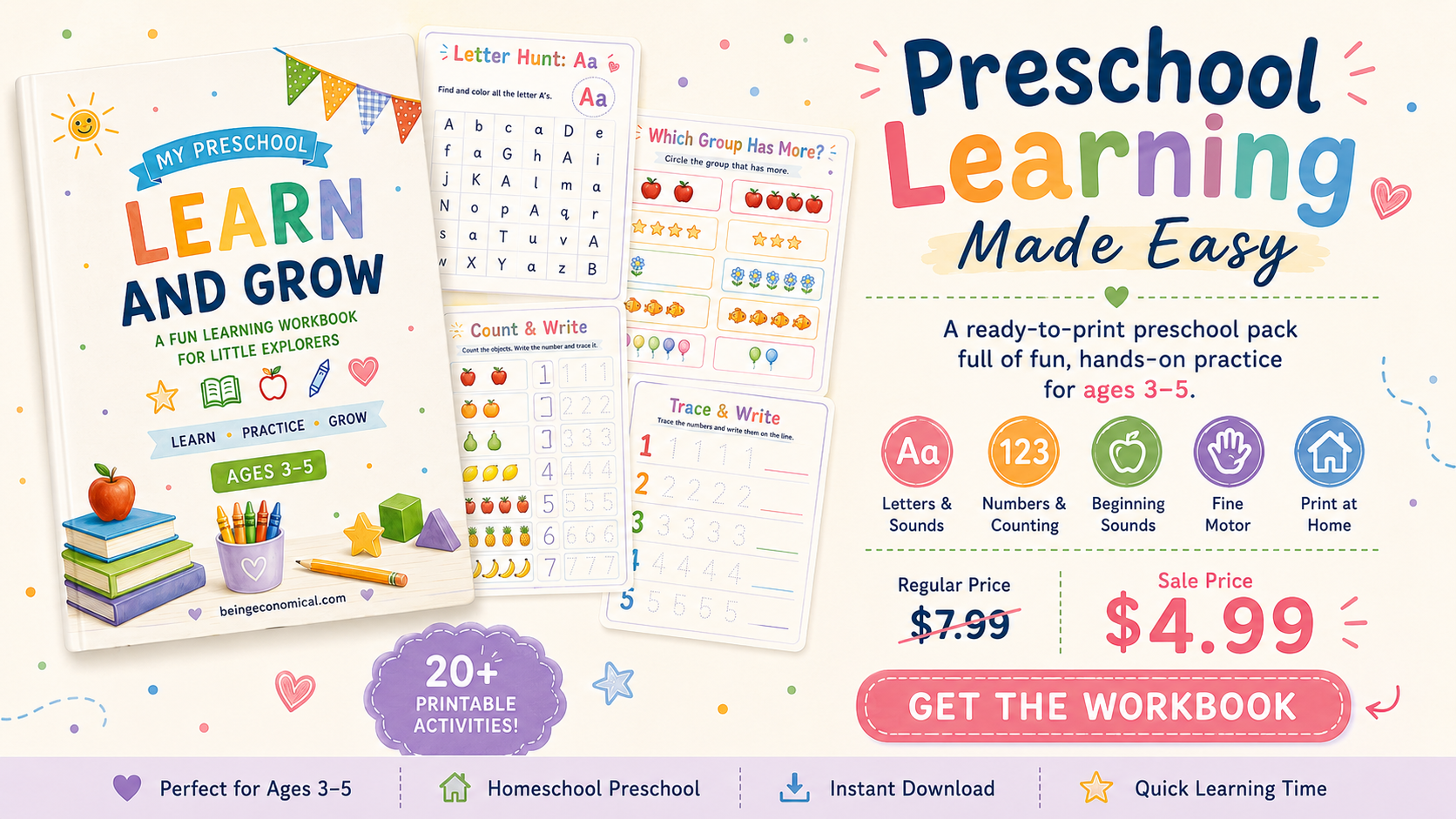
Get 20+ printable activities for ages 3–5 for just $4.99.
Skills practiced: fine motor skills, letter formation, numbers, creativity
5. Try a Color Sorting Game
Place a handful of colorful objects on the floor and ask your child to sort them.
You can use blocks, pom-poms, toy cars, cereal pieces, buttons, magnetic tiles, or anything else that comes in several colors.
Once color sorting is easy, sort by size, shape, type, or another characteristic.
Skills practiced: classification, colors, early math, reasoning
6. Make Patterns With Toys
Patterns are another easy early math skill to work into play.
Start something simple like:
red block, blue block, red block, blue block…
Then ask your child what comes next.
Eventually, try more complicated patterns like red-red-blue or car-dinosaur-car-dinosaur.
Skills practiced: patterns, prediction, logical thinking
7. Have a Preschooler-Friendly Cooking Lesson
One of the best classrooms in our house is the kitchen.
Let your four-year-old help pour ingredients, scoop flour, count spoonfuls, wash produce, stir batter, or arrange ingredients.
Talk about measurements, colors, textures, smells, and what happens as food cooks.
You don’t have to announce that you’re teaching math and science. Just cook together.
Skills practiced: math, science, vocabulary, fine motor skills, life skills
8. Use Scissors for Cutting Practice
Give your child child-safe scissors and scraps of paper to cut.
You can draw straight lines, zigzags, curves, and simple shapes for them to follow, or simply let them snip paper freely at first.

Cutting builds the small hand muscles children eventually use for writing.
Skills practiced: fine motor skills, hand-eye coordination, pre-writing skills
9. Make a Sticker Picture
Give your child stickers and a blank sheet of paper and let them create a picture or scene.
Peeling small stickers is excellent fine motor practice.

You can also add learning by asking your child to place three blue stickers on the page, make a pattern, sort stickers by type, or tell you a story about their picture.
Skills practiced: fine motor skills, counting, creativity, storytelling
10. Play “What Starts With…?”
Choose a letter sound and look around the house for things that begin with it.
For example:
“What can we find that starts with B?”
Book. Ball. Banana. Blanket.
At four, I keep this playful. If he doesn’t know an answer, I simply give him one instead of turning it into a test.
Skills practiced: beginning sounds, vocabulary, phonological awareness
11. Create an Indoor Obstacle Course
If your four-year-old is anything like mine, sometimes movement is exactly what learning needs.
Use pillows, painter’s tape, baskets, chairs, or other safe household items to create a simple obstacle course.
Then work learning into the directions:
“Jump four times.”
“Crawl under the chair.”
“Find the letter A before you move to the next station.”
“Put three balls in the basket.”
Skills practiced: gross motor skills, counting, listening, following directions
12. Practice Numbers With Sidewalk Chalk
Take learning outside with sidewalk chalk.
Write numbers on the ground and call one out for your child to jump on. Draw shapes and have them identify each one. Make a simple number line and hop from number to number.
You can do the same thing with letters.
Skills practiced: numbers, letters, gross motor skills
13. Let Them Build With Blocks
Building is learning.
Blocks, LEGOs, magnetic tiles, and other construction toys give preschoolers opportunities to plan, experiment, solve problems, compare sizes, create patterns, and understand how objects fit together.

Ask open-ended questions such as:
“What are you building?”
“What could make that tower stronger?”
“Which block do you think should go next?”
Then let them figure it out.
Skills practiced: STEM, spatial reasoning, problem-solving, creativity
14. Make a Simple Sensory Bin
You do not need a Pinterest-perfect sensory bin.
Fill a container with something your child can safely scoop and pour, then add cups, spoons, tongs, toys, letters, or other objects.
You can hide magnetic letters or numbers inside and have your child search for them.
Always choose materials appropriate for your child and supervise sensory play.
Skills practiced: sensory exploration, fine motor skills, letters, numbers
15. Play Grocery Store
Pretend play can cover an incredible amount of learning.
Set up a little grocery store with food from your pantry or play food. Let your preschooler shop, count items, sort food, make a list, or pretend to pay.
You can even write simple labels or prices together.
Skills practiced: counting, literacy, social skills, imaginative play
16. Read a Picture Book and Let Them Tell the Story
Instead of always reading every word yourself, occasionally look through a familiar picture book and ask your child to tell you what is happening.
There are no wrong answers.

Talk about the characters, objects, colors, feelings, and what your child thinks will happen next.
Books with busy, detailed illustrations are especially good for this because there is so much to find and discuss.
Skills practiced: vocabulary, comprehension, storytelling, observation
Looking for more preschool learning activities?
Get 20+ printable activities for ages 3–5 for just $4.99.
17. Make a Shape Hunt
Ask your child to find shapes throughout your home.
Can they find:
- A circle?
- A square?
- A rectangle?
- A triangle?
Once they find one, talk about the object.
A clock might be a circle. A door may be a rectangle. A cracker might be a square.
Skills practiced: shapes, observation, early geometry
18. Give Them Real-Life Jobs
Some of our best preschool learning doesn’t look educational at all.

A four-year-old can help:
- Match socks
- Sort laundry
- Put utensils away
- Wipe the table
- Water plants
- Feed a pet
- Put toys into categories
- Help make their bed
These simple jobs teach sequencing, sorting, responsibility, independence, and problem-solving.
Skills practiced: practical life skills, sorting, independence, responsibility
19. Draw a Person
Give your preschooler a blank piece of paper and ask them to draw themselves or someone in the family.
Instead of correcting the drawing, talk about it.
“Tell me about your picture.”
“What is this part?”
“What should we add next?”
You might be surprised by the details they notice.
Skills practiced: fine motor skills, body awareness, creativity, language
20. Try a Sink-or-Float Experiment
Fill a bowl or container with water and gather several safe household objects.
Before putting each item into the water, ask:
“Do you think this will sink or float?”
Then test it.
You don’t need a complicated science lesson. Simply making a prediction and checking the result introduces the basic idea of experimenting.
Skills practiced: science, prediction, observation, vocabulary
21. Match Uppercase and Lowercase Letters
Write uppercase letters on one set of cards and their lowercase matches on another.
Start with only three or four pairs at a time.
Let your child match A with a, B with b, and so on.
You can gradually add more as they get comfortable.
Skills practiced: alphabet recognition, matching, visual discrimination
22. Practice Counting With Snacks
Snack time counts as school now. You’re welcome.
Give your child crackers, berries, grapes, cereal pieces, or another favorite snack.
Ask them to count ten pieces, divide snacks into two groups, make a simple pattern, or tell you which pile has more.
And then they get to eat the lesson.
Skills practiced: counting, comparing quantities, sorting, patterns
23. Use a Dry-Erase Board for Low-Pressure Writing
Some children are much more willing to practice writing when it doesn’t feel permanent.
A small dry-erase board lets your four-year-old practice letters, shapes, numbers, and their name and immediately erase everything to start over.
There is something about that little eraser that makes writing considerably more exciting.
Skills practiced: handwriting, letter formation, number formation
24. Play “I Spy”
“I Spy” requires absolutely no setup and works almost anywhere.

Try:
“I spy something red.”
“I spy something that starts with B.”
“I spy something shaped like a circle.”
“I spy three things that are blue.”
This is an easy activity for the car, grocery store, doctor’s office, restaurant, or home.
Skills practiced: vocabulary, colors, sounds, shapes, observation
25. Let Them Choose the Activity
This one might be the most important.
Sometimes I give my four-year-old two or three choices and let him decide what he wants to do.
“Do you want to build letters with play dough, do our scavenger hunt, or paint?”
He is still learning, but he gets some control over how he learns.
And at four, that can make a huge difference.
How Long Should a 4 Year Old Do Learning Activities?
You do not need to recreate a six-hour school day at home.
For us, preschool learning works much better in short bursts throughout the day.
We might spend a few minutes working on letters, move on to free play, read later, practice counting while we’re doing something else, and work fine motor skills into an art project.
If your child is engaged, keep going.
If they’re clearly finished, it’s okay to move on.
The goal isn’t to see how long you can make a four-year-old sit still. The goal is to give them frequent opportunities to explore, practice, ask questions, and learn.

Learning Through Play Still Counts
One thing I wish more parents heard is that preschool learning does not have to look like a child sitting quietly over a stack of worksheets.
Building a tower requires problem-solving.
Pretending to run a restaurant uses language and math.
Looking for more preschool learning activities?
Get 20+ printable activities for ages 3–5 for just $4.99.
Drawing strengthens the hands they’ll use for writing.
Helping you cook introduces measurement.
Looking through books builds vocabulary.
Playing a board game teaches counting and taking turns.
There is learning hidden everywhere once you start looking for it.
And especially at four, I would rather protect my child’s curiosity and gradually build those academic skills than spend our day fighting over worksheets.

Our Favorite Preschool Learning Resources
If you want a little more structure than individual activities, having a few good preschool resources around can make learning at home much easier.
We use a mixture of books, hands-on activities, games, art supplies, building toys, and curriculum resources depending on what we’re working on.
I especially like having hands-on options available because my preschooler isn’t always interested in sitting down for traditional learning — but give him something he can build, touch, move, or figure out, and I have a much better chance of keeping him engaged.
Have a Younger Child Too?
If you also have a toddler at home, I put together a separate list of learning activities for 2-year-olds with easier ideas designed for that stage.
As I continue this series, I’ll also be sharing more learning ideas by age so you can find activities that actually fit the stage your child is in.
Pin these for later…


Frequently Asked Questions About Learning Activities for 4 Year Olds
What are good learning activities for a 4 year old?
Good learning activities for four-year-olds include letter hunts, counting games, puzzles, building activities, pretend play, play dough, simple science experiments, reading, drawing, sorting, pattern activities, and age-appropriate household jobs.
The best activities combine learning with something your child already enjoys.
What should I teach my 4 year old at home?
You can introduce letter recognition, letter sounds, counting, numbers, shapes, colors, patterns, name recognition, early writing, vocabulary, fine motor skills, problem-solving, and independence.
There is no need to master everything at once.
How do I teach my 4 year old who doesn’t want to learn?
First, consider changing what “learning” looks like.
If sitting with a workbook turns into a battle, try movement games, scavenger hunts, building, cooking, pretend play, art, or hands-on activities instead.
A child can learn letters while running across the backyard and learn math while building with blocks. Sometimes changing the activity is more effective than trying to convince a four-year-old to enjoy the original one.
Should a 4 year old be able to write their name?
Many preschoolers begin recognizing and attempting to write the letters in their names around this stage, but children develop at different rates.
You can practice name recognition through magnetic letters, tracing, play dough, puzzles, signs, and other playful activities in addition to pencil-and-paper writing.
Are worksheets good for 4 year olds?
Worksheets can be one tool, especially if your child genuinely enjoys them, but they do not need to make up the majority of preschool learning.
Four-year-olds can practice many of the same early academic skills through play, conversation, books, movement, art, building, games, and everyday routines.
Keep Preschool Learning Simple
If you’re trying to figure out how much your four-year-old should be learning every day, remember that you don’t have to do everything.
Pick an activity.
Read a book.
Count something.
Go outside.
Let them build.
Let them ask 847 questions.
And tomorrow, do a little more.
Those small moments really do add up.
Next: Read my Learning Activities for 2 Year Olds and Timberdoodle Kindergarten Curriculum Kit Review for even more ideas for learning at home.